


IHT planning for clients who have recently sold a business

THIS SCENARIO IS FOR ILLUSTRATIVE PURPOSES ONLY
Our Business Relief estate planning scenarios are based on situations advisers often encounter, making them a great starting point for discussions with your own clients.
In the last two months of 2025, the government made two important announcements relating to Business Relief. First, the Autumn 2025 Budget in late November announced that from April 2026, any unused portion of the £1 million allowance for 100% Business Relief and Agricultural Relief would be transferable between spouses and civil partners.
In December, the government also announced it would increase the £1 million allowance for 100% Business Relief to
£2.5 million from April 2026, with 50% relief continuing to apply to assets above that level. These changes mean Business Relief has an increasingly important role to play in IHT planning for clients with estates valued in excess of £1 million.
Meet Vijay and Anita
In this client planning example, Vijay and Anita, both in their 70s, recently sold their business, which had been eligible for Business Relief, for £5 million. Ill health means they are keen to discuss estate planning, and would dearly like to leave “their legacy” – particularly the sale proceeds – to their three children. They already have significant pension assets and the proceeds of the sale are not needed to support their lifestyle. For the time being, they plan to keep the proceeds as cash savings.
Using Business Relief to preserve a £5 million legacy
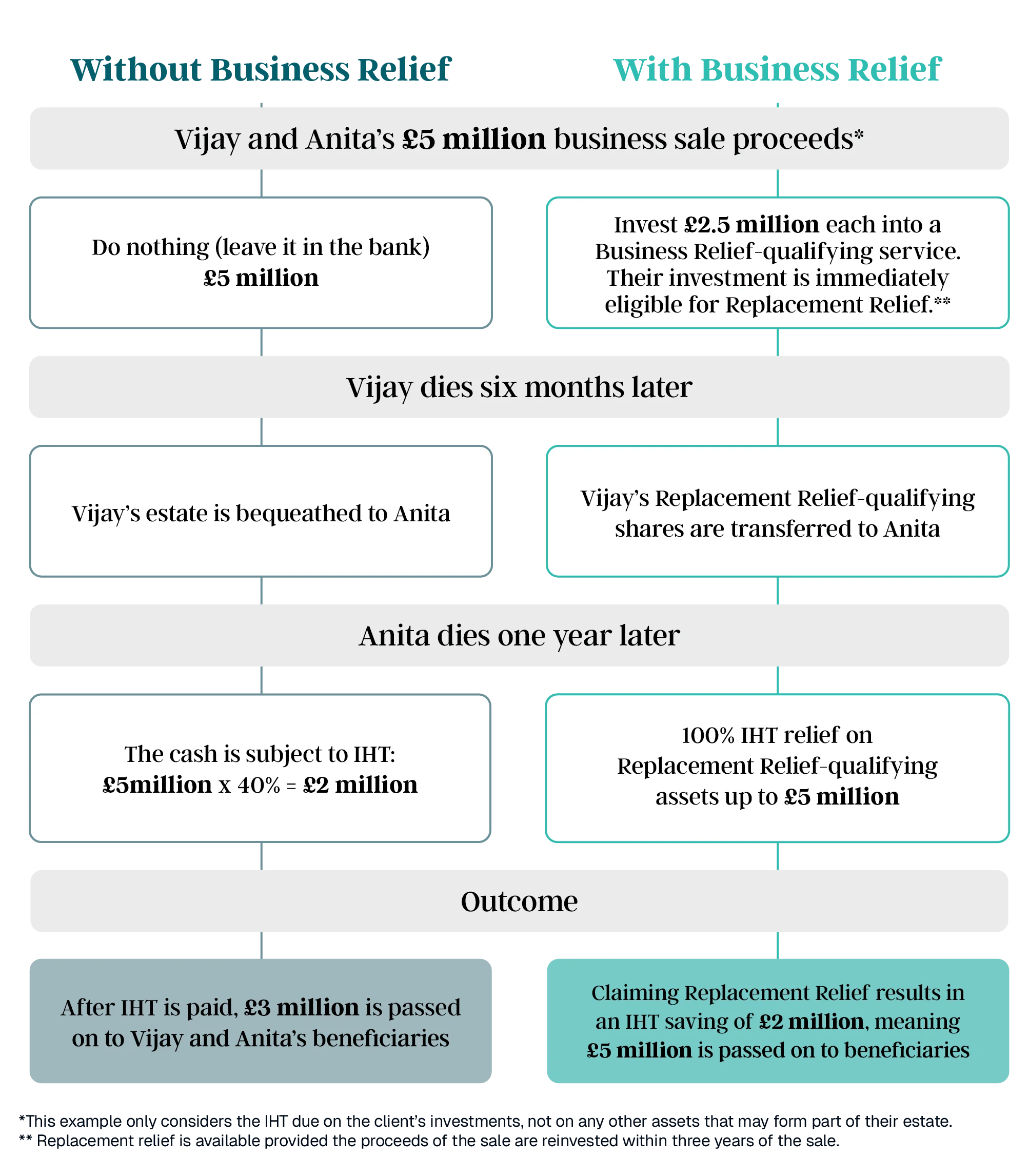
Vijay and Anita both plan to leave their entire estate to the surviving spouse, who will leave their combined assets to the children as beneficiaries. If Vijay and Anita do nothing, upon the death of the second spouse, the £5 million in cash savings will be subject to IHT at 40%, meaning just £3 million is inherited by their children. However, the couple’s financial adviser offers them an alternative.
Their adviser explains they could reinvest the business sale proceeds, £2.5 million each, into a Business Relief-qualifying service. To qualify for Business Relief, shares must have been held for at least two out of the last five years, and must also be held at death. But in this instance, the sale of the business would be considered ‘Replacement Relief’, negating the two-year clock. Vijay and Anita understand that a Business Relief-qualifying portfolio is a higher-risk investment, but it is within their capacity for loss and aligns with their estate planning objectives. After Vijay’s death, Anita inherits her husband’s estate, and upon her death, Anita’s estate can benefit from the new combined Business Relief allowance, meaning £5 million is exempt from IHT and can be passed on IHT-free to their children.
Investor’s capital is at risk. Target returns are not guaranteed. This client planning scenario does not take into account investment growth or charges for the investment. It is based on tax rules and personal allowances at April 2026, which could be subject to change and depend on individual circumstances. Tax reliefs depend on the investments maintaining their qualifying status for Business Relief. This scenario is for illustrative purposes only and should not be construed as investment or tax advice.